
Services
- Is furosemide available without prescription in the UK?
- What does Prescription Only Medicine (POM) mean in the UK?
- General information about furosemide
- How furosemide works: mechanism of action
- Price and availability information
- Strengths, formulations and pack types
- Indications: edema, hypertension and heart failure
- UK legal classification: POM
- Alternatives for fluid retention and hypertension
- Furosemide compared with other diuretics
- Food, alcohol and lifestyle considerations
- Side effects and tolerability
- Long-term use, tolerance and excessive exposure
- Warnings, contraindications and interactions
- Additional information about furosemide
Is furosemide available without prescription in the UK?
Furosemide is classified in the UK as a Prescription Only Medicine (POM). This means you cannot legally purchase or order furosemide tablets, generic or branded, without a valid prescription from a qualified prescriber such as a doctor or nurse practitioner. Any website offering purchase without prescription in the UK would be operating outside MHRA regulations, and such sources may pose serious safety risks.
While some international online pharmacies might advertise “furosemide without prescription” and claim to supply cheap products with fast delivery, UK law requires a prescription for dispensing and safe clinical oversight. Markeaton Pharmacy adheres strictly to MHRA guidelines, ensuring every order is backed by an appropriate prescription before dispensing. This process protects you from substandard, counterfeit or improperly dosed products.
If you need prescription furosemide with fast delivery within the UK, you can arrange for a private prescription and then purchase or order the medication online through reputable services like Markeaton Pharmacy. Always verify the credentials of the online pharmacy and ensure your prescription is valid and up to date.
What does Prescription Only Medicine (POM) mean in the UK?
A Prescription Only Medicine (POM) can only be supplied following a valid prescription written, signed or transmitted by a registered healthcare professional. In the UK, POM status is reserved for medicines that require professional assessment of benefit and risk, monitoring of side effects or dosage adjustment according to individual conditions such as kidney function or electrolyte balance.
Furosemide’s classification as POM reflects the need to supervise its potent diuretic effects and manage potential complications like dehydration, electrolyte disturbances and hypotension. The legal framework is governed by the Medicines Act 1968 and enforced by the Medicines and Healthcare products Regulatory Agency (MHRA). Pharmacies must hold the prescription and ensure appropriate counselling accompanies supply.
In practice, POM status means that you cannot add furosemide to your basket in a standard online shop alongside general sales items. Instead, you must submit a prescription or complete an online clinical questionnaire under a prescriber’s oversight. Markeaton Pharmacy provides integrated private prescribing services to facilitate safe and legal purchase and fast delivery in the UK.
General information about furosemide
What is furosemide?
Furosemide is a potent loop diuretic used to increase urinary excretion of water, sodium and other electrolytes. It is commonly prescribed to treat fluid retention (edema) in conditions such as heart failure, liver cirrhosis and kidney disorders, as well as to manage hypertension when thiazide diuretics alone are insufficient.
Drug class and chemical nature
As a loop diuretic, furosemide acts quickly to block the sodium-potassium-chloride transporter in the thick ascending limb of the loop of Henle in the kidney. It is a sulfonamide derivative and differs structurally from thiazide and potassium-sparing diuretics, providing a more aggressive diuretic effect.
Generic versus branded
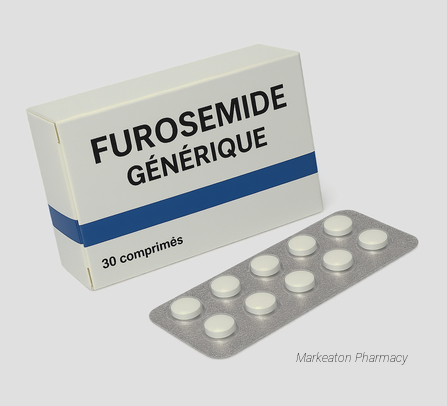
Generic furosemide contains the same active ingredient and dosage as branded equivalents. Regulatory authorities require bioequivalence, ensuring each tablet delivers the intended therapeutic effect. In the UK, generic formulations often offer significant cost savings, making them a cheaper choice for long-term treatment.
How furosemide works: mechanism of action
Site of action in the nephron
Furosemide targets the renal tubular cells in the thick ascending limb of the loop of Henle. By inhibiting the Na⁺-K⁺-2Cl⁻ co-transporter, it prevents reabsorption of sodium, chloride and potassium ions, leading to a marked diuresis and natriuresis (sodium loss).
Onset and duration of effect
Oral furosemide typically begins to work within 30 to 60 minutes after ingestion, with peak diuretic effect around 1–2 hours and lasting up to 6–8 hours. Intravenous administration produces an even faster response, but that route is restricted to hospital settings.
Comparison to other loop diuretics
Other loop diuretics such as bumetanide or torasemide share a similar mechanism but differ in potency, bioavailability and half-life. Furosemide remains the most widely used loop diuretic due to its well-documented profile, flexible dosing and generic availability.
Price and availability information
How much does furosemide cost in the UK?
The retail price for prescription furosemide depends on strength, pack size, brand or generic status, and pharmacy dispensing fees. Markeaton Pharmacy offers generic furosemide at competitive prices, often making it cheaper than branded versions. You may purchase or order bulk packs for lower per-tablet cost.
Online ordering and fast delivery
When ordering furosemide online in the UK, consider delivery speed and legal compliance. Markeaton Pharmacy provides free standard delivery on prescription orders and next-day delivery options for urgent needs. Always confirm your prescription is valid and complete the online clinical questionnaire if required.
Why prices vary
Differences in price reflect manufacturing costs, pack presentation, pharmacy markup, and dispensing fees. A lower cost generic does not imply inferior quality; all UK-authorised generics must meet strict MHRA standards. Ask Markeaton Pharmacy for current prices and any discount schemes.
| Product | Strength | Formulation | Price | Status | Note |
|---|---|---|---|---|---|
| Furosemide A | 40 mg | Tablets | Cheaper generic | POM | Prescription required; ask for price and delivery |
| Furosemide B | 20 mg | Tablets | Mid-range price | POM | Generic or branded; prescription required |
Strengths, formulations and pack types
Available strengths
In the UK, furosemide is commonly supplied in 20 mg and 40 mg oral tablets. Intravenous formulations exist for hospital use only. The choice of strength depends on the clinical indication, patient’s renal function and required diuretic response.
Pack sizes and patient needs
Pack sizes range from 28 to 100 tablets. Larger packs offer cheaper per-tablet prices but require careful storage and adherence monitoring. Markeaton Pharmacy can advise on the optimal pack size based on treatment duration and dosing schedule.
Generic versus branded packaging
Generic furosemide tablets may differ in color, shape, excipients and packaging compared to branded versions. Always check the tablet imprint and packaging information to ensure you receive the correct medicine and strength.
Indications: edema, hypertension and heart failure
Peripheral and pulmonary edema
Furosemide is first-line for treating fluid retention associated with congestive heart failure, hepatic cirrhosis with ascites and renal impairment. Rapid diuresis relieves symptoms like ankle swelling, breathlessness, and abdominal fullness.
Hypertension management
As part of combination therapy, furosemide may be used in patients with hypertension resistant to thiazide diuretics or in those with chronic kidney disease. Careful blood pressure monitoring is essential when adding or adjusting loop diuretics.
Off-label and special populations
Occasionally, furosemide is used off-label to manage hypercalcemia, acute pulmonary edema in emergencies, or certain drug overdoses. In paediatric and elderly populations, dosing must be tailored to body weight, renal function and overall clinical status.
UK legal classification: POM
Why is furosemide POM?
Due to its potent effect on fluid and electrolyte balance, furosemide requires medical supervision. Inappropriate self-medication can lead to dehydration, kidney injury, dangerously low blood pressure or severe electrolyte imbalances such as hypokalaemia.
Prescription and dispensing regulations
Pharmacies must retain prescriptions for at least two years and provide patient counselling on dosing, side effects and monitoring. Online pharmacies like Markeaton ensure that each order is cross-checked by a pharmacist against clinical guidelines.
Regulatory oversight
The MHRA regulates POM status and oversees reclassification processes. Any proposals to change furosemide’s status would require rigorous safety and usage data, which currently support its prescription-only classification.
Alternatives for fluid retention and hypertension
Thiazide diuretics
Thiazides such as bendroflumethiazide and metolazone act more distally in the nephron. They may be used for mild hypertension or combined with loop diuretics when higher diuretic effect is needed. They also carry risks of electrolyte loss.
Potassium-sparing diuretics
Spironolactone and amiloride retain potassium while promoting sodium excretion. They are often combined with furosemide to counter hypokalaemia but require monitoring of potassium levels to avoid hyperkalaemia, especially in renal impairment.
Osmotic and carbonic anhydrase inhibitors
Agents like mannitol or acetazolamide have specific indications such as raised intracranial pressure or metabolic alkalosis. They are not first-line for routine edema or hypertension but illustrate the diversity of diuretic mechanisms.
Furosemide compared with other diuretics
| Feature | Furosemide | Bendroflumethiazide | Spironolactone |
| Site of action | Loop of Henle | Distal tubule | Collecting duct |
| Potency | High | Moderate | Low-moderate |
| Electrolyte effect | Na⁺, K⁺, Cl⁻ loss | Na⁺, K⁺ loss | K⁺ retention |
| OTC availability | No, POM | No, POM | No, POM |
No single diuretic is universally superior; choice depends on indication, patient factors, comorbidities and desired electrolyte profile. Furosemide’s rapid, potent action makes it the agent of choice for acute decompensated heart failure or severe edema.
Food, alcohol and lifestyle considerations
Diet and electrolyte balance
Patients on furosemide should maintain a balanced diet rich in potassium-containing foods (e.g., bananas, oranges) to offset urinary potassium loss. Adequate fluid intake should be guided by a healthcare professional to avoid dehydration.
Alcohol and blood pressure
Alcohol can potentiate furosemide’s hypotensive effects and exacerbate dehydration. Patients should limit alcohol intake and monitor for symptoms such as dizziness or lightheadedness.
Lifestyle measures
Weight monitoring, daily fluid balance charts and blood pressure checks help guide dose adjustments. Low-sodium diets and gentle exercise also support diuretic therapy by reducing fluid retention and cardiovascular risk factors.
Side effects and tolerability
| Area | Examples described in product information |
| General | Dizziness, hypotension, dehydration |
| Gastrointestinal | Abdominal cramps, nausea |
| Electrolyte | Hypokalaemia, hyponatraemia, hypomagnesaemia |
| Renal | Azotemia, acute kidney injury if volume-depleted |
| Skin | Photosensitivity, rash |
Most side effects are dose-related and reversible with adjustment or discontinuation. Regular laboratory monitoring of electrolytes and renal function is key to safe long-term use of furosemide.
Long-term use, tolerance and excessive exposure
Chronic furosemide therapy can lead to tolerance, requiring dose escalation to maintain diuresis. Excessive exposure increases risk of hypovolaemia, renal impairment and electrolyte disturbances. Periodic medication review helps determine whether dose reduction or drug rotation is appropriate.
Excessive diuresis may present with confusion, severe weakness, pronounced thirst and acute kidney injury. Patients should report such symptoms promptly and hold the dose until assessed by a healthcare professional.
Long-term monitoring should include blood pressure, weight, renal function tests and serum electrolytes at regular intervals. Adjustments may be necessary based on clinical response and laboratory findings.
Warnings, contraindications and interactions
- Severe dehydration or electrolyte imbalance;
- Anuria (no urine output);
- Hypersensitivity to sulfonamides;
- Severe renal or hepatic impairment without specialist supervision;
- Concurrent NSAIDs may reduce diuretic effect;
- Potential interactions with lithium, digoxin, aminoglycosides;
- Use caution in diabetes due to risk of hyperglycaemia;
- Pregnancy and breastfeeding require specialist advice.
Furosemide interacts with multiple medicines through changes in volume status and electrolyte levels, as well as potential effects on renal clearance. Always review your full medication list with the pharmacy team.
Additional information about furosemide
Generic furosemide explained
A generic version meets identical standards of quality, safety and efficacy as the reference branded medicine. Differences may lie in tablet coating, colour, shape or inactive ingredients, but the active moiety and therapeutic effect remain equivalent.
Why dosage forms matter
Immediate-release tablets are the standard; however, for patients with swallowing difficulties, a compounded liquid formulation can be arranged under prescription. Special packaging is available to support adherence, such as blister packs or calendar boxes.
Verifying product information
Consult the electronic Medicines Compendium (eMC) or the MHRA database for the Summary of Product Characteristics and patient leaflet of your exact furosemide product. This ensures you understand the authorised indication, dosing, precautions and side effects.
Pharmacy advice
This information is provided by Markeaton Pharmacy, 126 Kedleston Road, Derby, DE22 1FX. It does not replace personalised advice from a pharmacist or other healthcare professional. For tailored recommendations, speak to our pharmacy team during your consultation.