
Services
- Is ciprofloxacin available without prescription in the UK?
- What does Pharmacy medicine mean in the UK?
- General information about ciprofloxacin
- How ciprofloxacin works against bacteria
- Price and availability information
- Strengths, formulations and pack types
- Common infections treated with cipro
- UK legal classification: GSL, P and POM
- Alternatives to ciprofloxacin
- Ciprofloxacin compared with other antibiotics
- Food, alcohol and lifestyle considerations
- Side effects and tolerability
- Antibiotic resistance and long-term use
- Warnings, contraindications and interactions
- Additional information about ciprofloxacin
Is ciprofloxacin available without prescription in the UK?
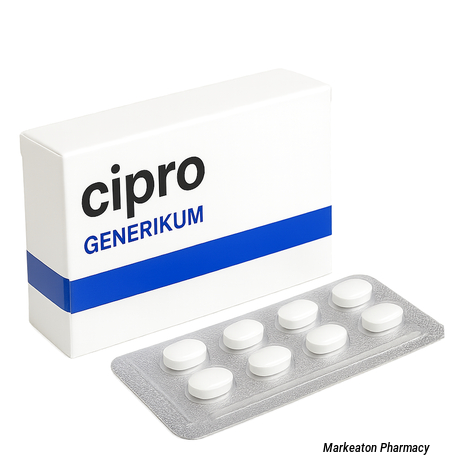
Ciprofloxacin (commonly known as Cipro) is classified as a Prescription Only Medicine (POM) in the UK. Legally, you cannot buy or purchase ciprofloxacin without prescription from a UK-registered pharmacy. Any offer to order cipro without prescription online or by phone is not supported by UK regulations. Markeaton Pharmacy strictly follows MHRA guidelines. However, for patients without a valid prescription we offer an online consultation service with our pharmacist to obtain a prescription where clinically appropriate. This ensures you can order generic or branded ciprofloxacin at a cheaper price, with fast delivery, safely and lawfully.
What does Pharmacy medicine mean in the UK?
In the United Kingdom there are three main legal classifications for medicines:
- Prescription Only Medicine (POM): requires a prescription from a qualified health professional.
- Pharmacy medicine (P): can be supplied without a prescription but only in a registered pharmacy, under the supervision of a pharmacist.
- General Sales List medicine (GSL): can be sold in retail outlets without supervision.
Ciprofloxacin is not a pharmacy medicine or GSL; it remains POM. This underscores the importance of professional oversight when using antibiotics to reduce the risks of resistance and side effects.
General information about ciprofloxacin
What is ciprofloxacin?
Ciprofloxacin is a broad-spectrum antibiotic belonging to the fluoroquinolone class. It is widely used to treat a variety of bacterial infections by inhibiting bacterial DNA replication.
What are fluoroquinolones?
Fluoroquinolones are a group of antibiotics that interfere with bacterial DNA gyrase and topoisomerase IV, enzymes essential for bacterial DNA replication and cell division. Other fluoroquinolones include levofloxacin, moxifloxacin, norfloxacin and ofloxacin.
What is the active ingredient?
The active pharmaceutical ingredient is ciprofloxacin hydrochloride. Generic products contain the same active moiety and must meet regulatory standards for purity, potency and safety.
Why are formulations important?
Ciprofloxacin is sensitive to gastric pH and can be formulated as immediate-release tablets, prolonged-release tablets, oral suspension and intravenous infusion. The formulation affects absorption rate, dosing regimen and bioavailability.
Is ciprofloxacin an antiviral or antifungal?
No. Ciprofloxacin is specifically active against bacteria. It has no direct effect on viruses or fungi and should not be used to treat viral or fungal infections.
Why do we need antibiotics like ciprofloxacin?
Antibiotics target bacterial pathogens. Ciprofloxacin is valued for its broad activity against Gram-negative and some Gram-positive bacteria, making it useful for urinary tract infections (UTIs), respiratory infections, gastrointestinal infections and skin infections, among others.
How ciprofloxacin works against bacteria
What is DNA gyrase?
DNA gyrase is an essential enzyme in bacteria that introduces negative supercoils into DNA, allowing compact packaging and facilitating replication. Topoisomerase IV separates interlinked DNA during bacterial cell division.
How does ciprofloxacin inhibit bacteria?
Ciprofloxacin binds to the DNA-enzyme complexes of DNA gyrase and topoisomerase IV, stabilizing the cleavage complex and preventing DNA replication. This leads to bacterial death (bactericidal effect).
Does ciprofloxacin act on all bacteria?
No. While ciprofloxacin has broad Gram-negative coverage, activity against certain Gram-positive bacteria (e.g., staphylococci) is variable. It does not cover anaerobes or atypical organisms comprehensively.
Why is bactericidal action important?
Bactericidal antibiotics, like ciprofloxacin, kill bacteria directly. This can be advantageous in severe infections or in immunocompromised patients where rapid bacterial clearance is desired.
How quickly does ciprofloxacin work?
Oral ciprofloxacin is absorbed into the bloodstream within 1–2 hours. Clinical improvement can begin within 24–48 hours for many infections, but the full course must be completed to prevent resistance.
Does food affect absorption?
Food can delay absorption, but the effect on overall bioavailability is modest. However, dairy products, calcium-fortified juices or antacids containing aluminium, magnesium or calcium can significantly reduce ciprofloxacin absorption and should be spaced apart by at least 2 hours.
Price and availability information
How much does ciprofloxacin cost in the UK?
Price for ciprofloxacin varies by brand, generic status, pack size and retailer. Generic ciprofloxacin tablets are generally cheaper than branded versions like Ciproxin. Online pharmacies may offer discounts or bulk-purchase savings. Our online price overview below is for information; actual prices may vary.
Why do prices vary?
Variations reflect manufacturing costs, brand premiums, pack size, wholesale agreements and retailer pricing strategies. Bulk orders or promotions can result in cheaper unit prices.
| Product | Strength | Formulation | Pack Size | Approx. Price | Status |
|---|---|---|---|---|---|
| Generic Ciprofloxacin | 500 mg | Immediate-release tablet | 10 tablets | £12.99 | Prescription only |
| Ciproxin | 500 mg | Immediate-release tablet | 10 tablets | £24.50 | Prescription only |
| Generic Ciprofloxacin | 250 mg | Prolonged-release tablet | 20 tablets | £18.75 | Prescription only |
Strengths, formulations and pack types
What strengths of ciprofloxacin exist?
Ciprofloxacin is commonly available in 250 mg, 500 mg and 750 mg oral tablet strengths. There are also 500 mg prolonged-release tablets, 250 mg/5 mL oral suspension and intravenous preparations.
What formulations are available?
Formulations include immediate-release tablets, prolonged-release tablets, oral suspension for paediatric or dysphagic patients, and intravenous solution for hospital use.
Why does pack size matter?
Pack size is linked to the authorised treatment duration for specific indications. For example, a 10-tablet pack of 500 mg tablets may cover a five-day course for certain infections, while larger packs may be used for longer regimens under supervision.
| Feature | Why it matters |
| Strength | Determines dose per tablet |
| Formulation | Influences absorption and dosing schedule |
| Pack size | Matches recommended treatment course |
| Legal category | Prescription only (POM) |
Are generic and branded ciprofloxacin identical?
Generics must contain the same active ingredient and demonstrate bioequivalence to branded products. Inactive ingredients, tablet size, colour and packaging may differ.
Common infections treated with cipro
What urinary tract infections (UTIs) does ciprofloxacin treat?
Ciprofloxacin is often prescribed for complicated or recurrent UTIs caused by susceptible Gram-negative bacteria, including E. coli and Proteus species.
What respiratory infections?
It can treat certain lower respiratory tract infections, such as bronchitis or pneumonia, when first-line antibiotics are unsuitable or when the causative organism is resistant to other agents.
What gastrointestinal infections?
Ciprofloxacin is used for travellers’ diarrhoea, dysentery and enteric fever caused by Salmonella, Shigella or Campylobacter.
What skin and soft tissue infections?
It may be used for cellulitis or wound infections, especially in mixed infections or when Pseudomonas aeruginosa is involved.
What bone and joint infections?
Ciprofloxacin can be part of combination therapy for osteomyelitis or septic arthritis due to Gram-negative organisms.
Is ciprofloxacin used for sexually transmitted infections?
Fluoroquinolones were previously used for chlamydia or gonorrhoea, but increasing resistance has limited their role. Current guidelines favour other antibiotics.
UK legal classification: GSL, P and POM
What is a POM?
Prescription Only Medicine requires a prescription. Ciprofloxacin is POM due to its classification as an antibiotic with potential for serious side effects and resistance.
What is a Pharmacy medicine?
Pharmacy medicines can be sold without a prescription but only under pharmacist supervision. These are labelled as “P” on packaging.
What is a GSL medicine?
General Sales List medicines can be sold in shops without supervision. Antibiotics are never GSL.
Why is ciprofloxacin POM?
Its use requires accurate diagnosis, susceptibility testing, dosage adjustment in renal impairment and monitoring for interactions and adverse effects.
Who regulates medicines in the UK?
The Medicines and Healthcare products Regulatory Agency (MHRA) oversees classification, licensing and safety monitoring of medicines in the UK.
Alternatives to ciprofloxacin
What other antibiotic classes exist?
- Penicillins (e.g., amoxicillin, co-amoxiclav);
- Cephalosporins (e.g., cefalexin, cefuroxime);
- Macrolides (e.g., azithromycin, clarithromycin);
- Tetracyclines (e.g., doxycycline);
- Sulfonamides (e.g., trimethoprim-sulfamethoxazole);
- Aminoglycosides (e.g., gentamicin);
- Carbapenems (e.g., meropenem).
The choice depends on infection site, pathogen susceptibility, patient factors and antibiotic stewardship principles.
Ciprofloxacin compared with other antibiotics
How does ciprofloxacin differ from penicillins?
Ciprofloxacin is bactericidal via DNA inhibition, while penicillins inhibit cell wall synthesis. Ciprofloxacin covers some Gram-negative bacteria resistant to penicillins.
How does it compare with macrolides?
Macrolides like azithromycin inhibit protein synthesis. They have different spectra, often used for atypical respiratory pathogens, whereas ciprofloxacin targets many Gram-negative rods.
| Feature | Ciprofloxacin | Amoxicillin | Azithromycin |
| Drug class | Fluoroquinolone | Penicillin | Macrolide |
| Main mechanism | Inhibits DNA replication | Cell wall synthesis | Protein synthesis |
| Spectrum | Broad Gram-negative | Gram-positive & some Gram-negative | Mostly Gram-positive & atypicals |
| OTC availability UK | No (POM) | No (POM) | No (POM) |
Is one antibiotic always better?
No. Selection is based on the identified or suspected pathogen, site of infection, local resistance patterns, patient allergies and pharmacokinetics.
Food, alcohol and lifestyle considerations
Can diet influence antibiotic effectiveness?
While ciprofloxacin absorption can be reduced by dairy products and antacids, diet generally does not affect bacterial susceptibility. Always follow timing instructions on your prescription.
Can alcohol affect treatment?
Moderate alcohol may not interact directly with ciprofloxacin, but alcohol can exacerbate side effects like dizziness or stomach upset. Avoid excessive drinking during therapy.
Does smoking matter?
Smoking does not directly alter ciprofloxacin action but may worsen respiratory infections and slow healing.
Should you adjust exercise?
Ciprofloxacin can increase risk of tendonitis or tendon rupture, especially with strenuous exercise. Avoid high-impact activities while on treatment and for a week after finishing.
Side effects and tolerability
Can ciprofloxacin cause side effects?
Yes. Common adverse events include gastrointestinal upset, headache, dizziness and rash. Serious effects are less common but well documented in product information.
| System | Possible side effects |
| Gastrointestinal | Diarrhoea, nausea, abdominal pain |
| Nervous system | Headache, dizziness, confusion (rare) |
| Musculoskeletal | Tendonitis, tendon rupture |
| Skin | Photosensitivity, rash |
| Hypersensitivity | Anaphylaxis (rare) |
Why are tendon injuries a concern?
Fluoroquinolones carry a boxed warning for tendon damage. Risk is higher in older adults, those on corticosteroids or patients with renal impairment.
Are weight gain or fatigue common?
These are not typical. If you experience unusual fatigue or weakness, contact your healthcare provider.
What about C. difficile infection?
Antibiotic use can alter gut flora, increasing risk of Clostridioides difficile colitis. Seek medical advice if you develop severe diarrhea.
Antibiotic resistance and long-term use
Why is stewardship important?
Inappropriate or prolonged use of ciprofloxacin can promote resistant bacterial strains. Use antibiotics only when prescribed and complete the full course.
Can resistance develop during therapy?
Yes. Subtherapeutic levels or premature discontinuation can select for resistant organisms, making future infections harder to treat.
What if infections recur?
Recurrent infection may require culture and sensitivity testing to guide alternative antibiotic therapy.
Why avoid unnecessary repeat courses?
Repeated courses without investigation can mask serious conditions and accelerate resistance development.
Warnings, contraindications and interactions
Who should be cautious with ciprofloxacin?
- People with a history of tendon disorders;
- Patients with myasthenia gravis (risk of exacerbation);
- Those with severe renal impairment (dose adjustment needed);
- Pregnant or breastfeeding women (use only if benefit outweighs risk);
- Children (fluoroquinolone use in paediatrics is limited to specific indications).
Can ciprofloxacin interact with other medicines?
Yes. Notable interactions include:
- Antacids and mineral supplements (reduce absorption);
- Caffeine (reduced clearance can increase caffeine effects);
- Theophylline (risk of toxicity);
- Warfarin (INR monitoring advised);
- Cyclosporine and tacrolimus (serum levels can rise).
Why avoid sun exposure?
Ciprofloxacin can cause photosensitivity reactions. Use sunscreen and protective clothing during therapy.
What about QT prolongation?
Fluoroquinolones may prolong the QT interval. Use with caution in patients with cardiac arrhythmias or those on other QT-prolonging drugs.
Additional information about ciprofloxacin
What does “generic ciprofloxacin” mean?
Generic ciprofloxacin contains the same active ingredient as branded formulations. It meets the same standards for efficacy and safety but is typically cheaper.
Why do leaflets differ?
Different manufacturers may include specific excipients, indications, legal requirements and patient information. Always read the leaflet supplied with your pack.
Why follow the exact product information?
Regulation applies to each marketed product. The Summary of Product Characteristics and patient leaflet provide crucial details on dosing, contraindications and interactions.
Where can UK medicine information be verified?
Reliable sources include the MHRA website, electronic Medicines Compendium (eMC) and qualified healthcare professionals.
Does this information replace pharmacist advice?
No. This page is general information by Markeaton Pharmacy, 126 Kedleston Road, Derby, DE22 1FX. For personalised advice, speak to our pharmacy team in store or via our online consultation service.